


The Language of Luxury: Understanding the 36 Stitches of Authentic Lucknowi Chikankari — From the Most Precious to the Most Foundational

In the world of true luxury, value is rarely loud.
It does not scream through logos, glitter, or excess. It reveals itself quietly—in precision, patience, heritage, and craftsmanship.
This is exactly what defines authentic Lucknowi Chikankari.
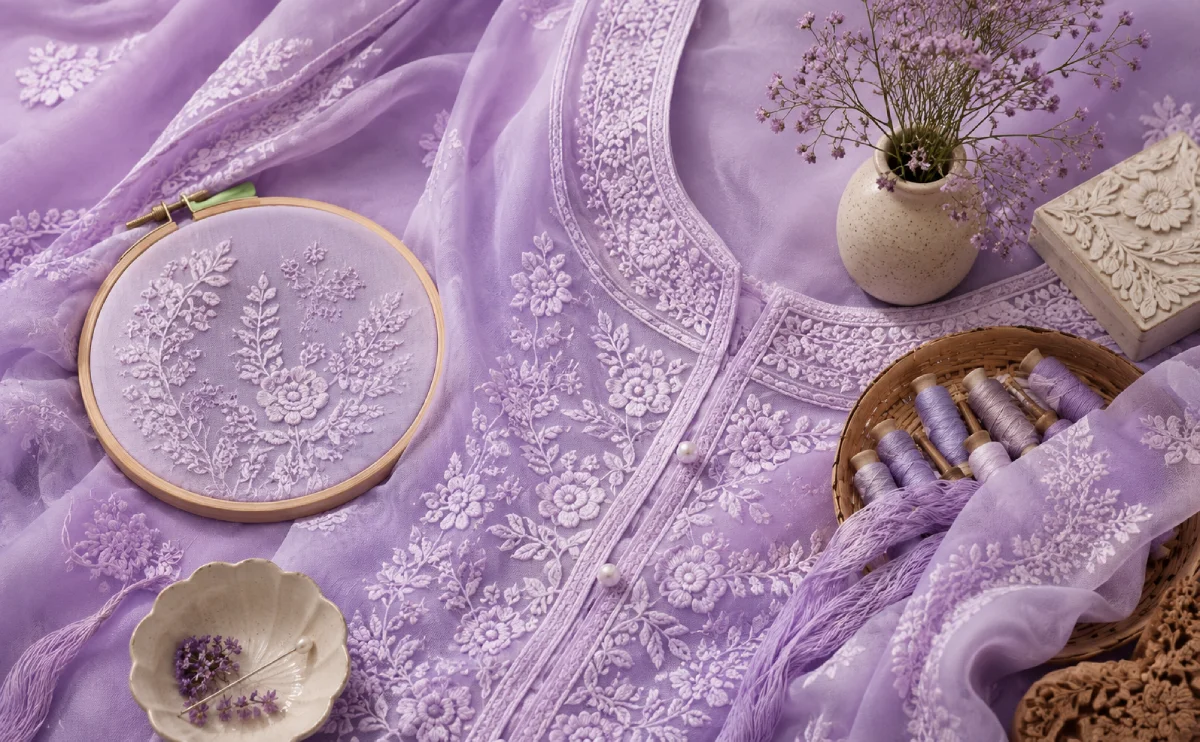
To many, Chikankari may appear to be simply beautiful white embroidery on soft fabrics. But to those who understand the art, it is one of the most technically refined forms of hand embroidery in the world.
Every motif carries intention. Every shadow, knot, floral detail, mesh effect, and raised texture is created by hand. No shortcuts. No factory repetition. No machine can recreate the soul of it.
Traditionally, Chikankari is known to include around 32 to 36 distinctive stitches, depending on regional variations and artisan lineage. Some stitches are simple and foundational, while others are so complex and rare that they are considered heirloom-level craftsmanship.
The most expensive Chikankari garments are not expensive because of branding.
They are expensive because of time.
Because of the human hand.
Because of stitches like Jaali, Murri, Phanda, and Bakhiya that demand years of mastery and cannot be rushed.
At Fiza Chikan, we believe true luxury begins with understanding.
So here is the complete hierarchy of iconic Lucknowi Chikankari stitches—from the rarest and most precious to the most foundational.
Tier One: The Crown Jewels of Chikankari
The Most Expensive and Prestigious Stitches
These are the stitches that define museum-worthy craftsmanship.
They require extraordinary artisan skill, immense patience, and years of training.
These are the stitches that make a garment priceless.
1. Jaali — The Highest Form of Chikankari Luxury
Jaali is widely considered the most prestigious and expensive stitch in authentic Chikankari.
Unlike embroidery that sits on top of fabric, Jaali transforms the fabric itself.
It creates an intricate net-like mesh without cutting threads.
The artisan carefully separates and manipulates the weave of the cloth by hand, forming a delicate openwork pattern while preserving the strength of the fabric.
This is not stitching.
This is surgical craftsmanship.
True handmade Jaali requires extraordinary control because one wrong movement can damage the fabric permanently.
Machine-made imitations exist, but they lack the softness, irregular beauty, and soul of genuine hand-done Jaali.
When a garment carries real Jaali work, it belongs to the highest luxury category.
This is why Jaali pieces are among the most expensive in the world of Chikankari.
2. Hathkati Jaali — Lace-Like Royal Craftsmanship
Hathkati Jaali is an even more refined variation of Jaali.
It creates a lace-like softness with extreme delicacy and intricate spacing.
It feels almost architectural in its precision.
This stitch requires even greater control than standard Jaali because the weave manipulation is finer and more fragile.
It is rare, highly labor-intensive, and often found only in exceptional handcrafted pieces.
This is couture-level embroidery.
3. Murri — The Rice Grain of Perfection
Murri is one of the most difficult raised stitches in Chikankari.
It appears as tiny elongated knots shaped like grains of rice.
Simple to describe.
Extremely difficult to execute.
Each Murri must be uniform, refined, and perfectly placed.
A poor Murri instantly reveals weak craftsmanship.
A perfect Murri reveals mastery.
It is often used in fine floral work and luxury heirloom garments where detail matters more than visual loudness.
Murri is expensive because precision is expensive.
4. Phanda — The Luxury of Tiny Knots
Phanda resembles tiny millet grains or flower buds.
It is a small rounded knot stitch used to create floral centres and delicate surface detailing.
Its beauty lies in consistency.
Every knot must match.
Every placement must feel natural.
It is subtle, but luxury is often subtle.
Phanda-heavy garments require enormous handwork, making them significantly more valuable than simpler embroidered pieces.
5. Hool — Delicate Floral Eyelets
Hool is one of the most elegant Chikankari stitches.
A tiny hole is created in the fabric and then finished beautifully with thread around it.
It is often used in flower centres and delicate botanical motifs.
Hool creates softness, femininity, and airy refinement.
Because the fabric must be handled delicately without damage, Hool demands experience and precision.
It is often seen in finer premium garments.
6. Keel Kangan — Ornamented Floral Grandeur
Keel Kangan creates petal-like floral richness.
It adds dimension and ornamental sophistication to festive and bridal garments.
This stitch carries visual richness without becoming heavy.
It reflects the Nawabi heritage of Lucknow—regal, elegant, and refined.
Because of its layered execution and decorative detail, it sits firmly in the premium category.
Tier Two: Signature Luxury Stitches
The Identity of Authentic Chikankari
These stitches define the language of true Lucknowi work.
They are iconic, recognizable, and deeply associated with heritage.
7. Kangan
Kangan creates circular, bracelet-like ornamental forms.
It is often used in floral motifs and decorative borders.
Its beauty depends entirely on symmetry and neatness.
Poor Kangan looks obvious.
Perfect Kangan looks effortless.
That effortlessness is luxury.
8. Kaudi (Kauri)
Named after the shape of a cowrie shell, Kaudi is a raised stitch with sculptural texture.
It adds dimensional beauty to motifs and requires precision to maintain its shape.
It is highly valued when executed in dense luxury work.
9. Makra
Makra resembles a delicate spider-web effect.
It creates textural beauty and intricate detailing.
Because it must remain neat and balanced, it demands discipline and fine control.
This is a detail-focused luxury stitch.
10. Ghas Patti
Ghas Patti means grass leaf.
It creates slender leaf-like forms inspired by nature.
This stitch is extremely important in floral Chikankari compositions.
The finer and denser the leaf work, the more luxurious the piece becomes.
Luxury lives in density.
11. Dhania Patti
Dhania Patti resembles coriander leaves.
It gives natural movement and softness to floral motifs.
Its elegance lies in how delicately it flows across the garment.
This stitch is widely loved in refined daywear and occasion pieces.
12. Chana Patti
Chana Patti creates rounded seed-like leaf structures.
It gives motifs fullness and ornamental richness.
It is visually rich and especially beautiful in premium floral compositions.
Tier Three: The Soul of Chikankari
The Famous Heritage Stitches
These are the stitches most people recognize, especially Bakhiya.
They are the heart of Lucknowi embroidery.
13. Bakhiya — The Famous Shadow Work
Bakhiya is the soul of Chikankari.
It is the most recognized stitch and the signature of authentic Lucknowi hand embroidery.
Known as shadow work, it is stitched from the reverse side of the fabric so the thread creates a soft shadow effect on the front.
It looks elegant, quiet, and deeply refined.
Bakhiya is especially beautiful on muslin, cotton voile, chiffon, and georgette.
It is the visual definition of quiet luxury.
14. Ulti Bakhiya
Ulti Bakhiya is reverse shadow work and one of the strongest signs of authenticity.
It creates a soft diffused texture that machines cannot replicate with the same grace.
This stitch feels almost poetic on sheer fabrics.
It is subtle, but unforgettable.
15. Seedhi Bakhiya
Seedhi Bakhiya is worked from the front and creates a fuller, more visible effect than Ulti Bakhiya.
It is used where stronger embroidery presence is needed.
It balances softness with structure.
16. Darzdari
Darzdari resembles seam-like structure.
It adds shape, strength, and definition to motifs.
It often supports larger compositions and borders.
Luxury needs structure.
Darzdari provides it.
17. Pechani
Pechani is delicate outlining.
It sharpens motifs and gives them definition.
Without Pechani, many designs would lose their clarity.
It is subtle architecture.
18. Bijli
Bijli means lightning.
It creates sharp decorative movement in motifs.
It adds energy and modernity to traditional work.
Its angular precision makes it visually striking.
19. Banjkali
Banjkali is used in floral and botanical compositions.
It adds layered texture and richness to nature-inspired patterns.
When done finely, it elevates the entire garment.
20. Sazi
Sazi enhances surface richness.
It fills and strengthens motifs.
It may not be the hero stitch, but without it, the luxury feels incomplete.
Tier Four: Structural Beauty
Supporting Luxury Through Detail
These stitches may not be the most glamorous, but they are essential.
They hold the design together.
21. Karan
Karan creates smooth filled areas, almost satin-like in appearance.
It is used where motifs require visual weight and density.
This is controlled richness.
22. Kapkapi
Kapkapi adds fine decorative texture.
It supports more elaborate stitch combinations and gives refinement to surface work.
It is detail-driven luxury.
23. Madrazi
Madrazi belongs to older traditional stitch vocabulary.
It is less commonly discussed in retail descriptions today, but remains important in serious artisan work.
It represents heritage knowledge.
24. Bulbul Chashm
Meaning “nightingale’s eye,” this stitch creates delicate eye-like ornamental details.
It is poetic, refined, and beautifully symbolic.
25. Bulbul
Bulbul creates tiny decorative accents related to eye-inspired detailing.
It adds intricacy and softness.
Often small, always important.
26. Taj Mahal
This refers to an ornamental stitch style associated with architectural beauty and refined decoration.
It reflects grandeur and elegance.
Its value lies in decorative richness.
Tier Five: Borders, Lines, and Definition
Precision That Shapes the Garment
These stitches create order, balance, and finish.
Luxury requires discipline.
These stitches provide it.
27. Janjeera (Zanzeera)
Janjeera means chain.
It is a chain stitch used for outlines and borders.
Beautiful Janjeera work feels controlled and elegant.
Messy Janjeera destroys luxury.
Precision matters.
28. Rahet
Rahet is a stem-like raised stitch used for outlines.
It gives direction and strength to motifs.
It is quiet but essential.
29. Turpai
Turpai is a hemming and finishing stitch.
It may not be decorative, but finishing defines quality.
Luxury is often judged at the edges.
30. Baalda
Baalda is part of traditional Chikankari vocabulary and contributes to structural detailing.
It supports mixed-stitch compositions beautifully.
31. Jora
Jora refers to joining and pairing motif structures.
It helps maintain design harmony.
Without structure, beauty feels incomplete.
Tier Six: The Foundation
Where All Chikankari Begins
Luxury does not begin at the top.
It begins at the foundation.
32. Tepchi — The Simplest Yet Essential Stitch
Tepchi is the most basic and foundational Chikankari stitch.
It is a long running stitch used to outline motifs and create linear patterns.
It is the beginning of everything.
Because it is simpler and faster to execute, it usually sits at the bottom of the pricing hierarchy.
But simplicity is not weakness.
It is discipline.
Even the grandest Jaali masterpiece begins with basic control.
Tepchi is proof that luxury starts with fundamentals.
Why Authentic Chikankari Is Priceless
When customers ask why authentic hand embroidery costs more, the answer is simple:
Because time costs.
Skill costs.
Human artistry costs.
A machine produces repetition.
An artisan produces soul.
This is why true Lucknowi Chikankari can never be compared to bulk-produced factory fashion.
It is not just clothing.
It is history stitched by hand.
At Fiza Chikan, we do not believe in selling garments. We believe in preserving craftsmanship…because real luxury is not bought. It is understood.