


The Language of Chikankari Motifs: What Flowers, Vines and Paisleys Represent

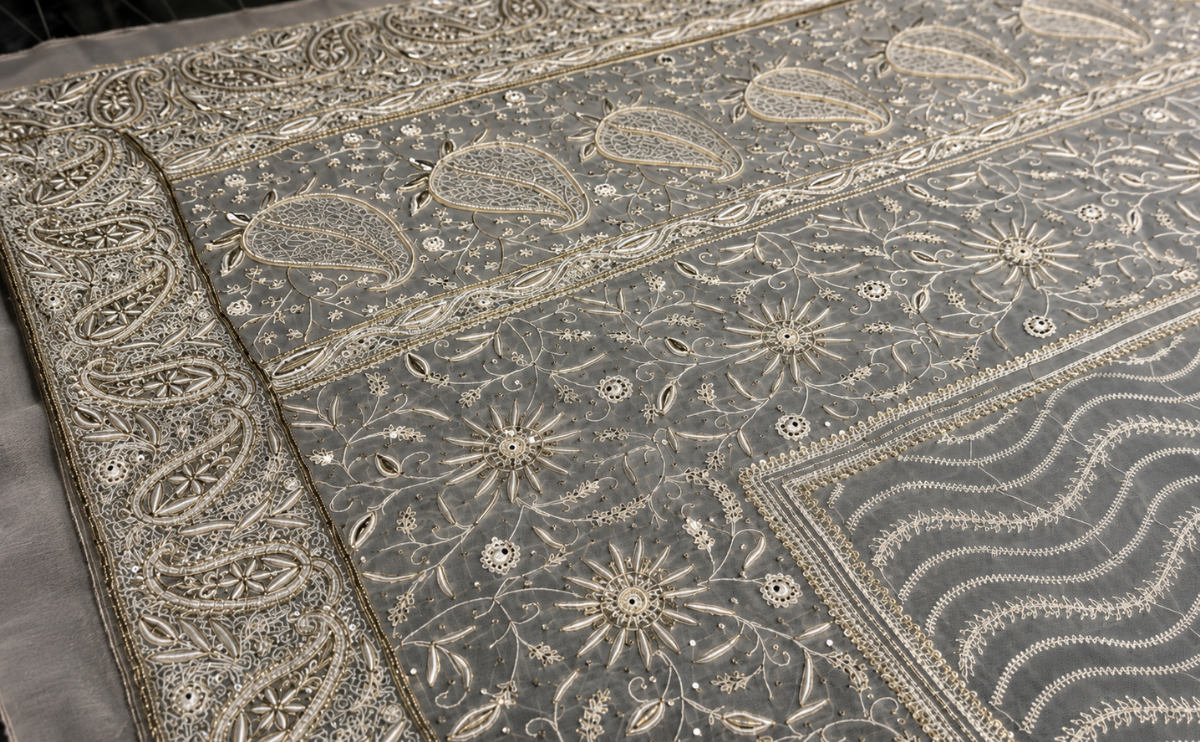
The Language of Chikankari Motifs: Decoding the Flowers, Vines and Paisleys of Lucknow’s Embroidered Heritage
To appreciate authentic Lucknowi Chikankari is to look beyond the stitches.
Every flower, vine, leaf and paisley embroidered onto the fabric carries traces of a centuries-old artistic vocabulary developed in the courts, gardens and cultural landscape of Awadh. Long before embroidery became a commercial craft, these motifs served as visual expressions of beauty, refinement, abundance and humanity’s enduring relationship with nature.
The delicate motifs that define Chikankari are not random decorative elements. They are part of a design language refined over generations of artisans, inspired by Mughal aesthetics, Persian influences, Indian flora and the natural world that surrounded the craftsmen of Lucknow.
The Garden as Inspiration
Many historians and textile scholars associate the flourishing of Chikankari with the artistic environment of Mughal India, where gardens were regarded as earthly reflections of paradise. The geometric layouts, flowering plants, flowing water channels and carefully cultivated landscapes of Mughal gardens became recurring sources of inspiration for artisans across architecture, painting, weaving and embroidery.
Chikankari absorbed this visual culture beautifully.
Its embroidered surfaces often resemble miniature gardens unfolding across fabric—filled with blossoms, leaves, tendrils and delicate botanical forms rendered entirely by hand.
Floral Motifs: The Soul of Chikankari
Flowers remain the most iconic motifs in Lucknowi Chikankari embroidery.
Rose-inspired blooms, jasmine-like flowers, lotus forms and stylised blossoms appear in countless variations, from tiny scattered bootis to elaborate all-over jaal patterns. These motifs traditionally symbolise beauty, purity, renewal and the cyclical nature of life.
The extraordinary appeal of Chikankari lies in the restraint with which these floral forms are executed. Rather than relying on colour, artisans create depth, texture and dimension through needlework alone. Light and shadow become part of the design, giving the embroidery its characteristic ethereal quality.
Creepers and Vines: Movement Woven into Fabric
Flowing creepers and winding vines are among the most recognisable elements of traditional Chikankari design.
Known for their graceful movement across the fabric, these motifs create visual continuity and connect individual floral elements into a harmonious whole. Their uninterrupted flow symbolises growth, interconnectedness and the continuity of life.
Whether framing a neckline, cascading along a dupatta border or extending across an entire garment, vine motifs lend rhythm and elegance to the composition.
Leaves and Foliage: Nature’s Quiet Architecture
If flowers provide emotion, leaves provide structure.
The foliage motifs found in Chikankari embroidery are often inspired by local plant forms and natural vegetation. They balance floral compositions, add depth to larger patterns and showcase the artisan’s ability to transform simple botanical shapes into intricate works of art.
Executed through traditional stitches such as Bakhiya, Ghas Patti and Pechni, these motifs demonstrate the technical sophistication for which Lucknowi Chikankari is renowned worldwide.
The Paisley: A Motif That Travelled Across Continents
Few textile motifs have enjoyed a journey as remarkable as the paisley.
Known in India as the mango motif or ambi, its curved silhouette has appeared in South Asian textiles for centuries. The design later travelled through trade routes to Europe, where it became so closely associated with the Scottish town of Paisley that it eventually adopted the name by which it is recognised internationally today.
In Indian artistic traditions, the mango symbolises fertility, prosperity, abundance and auspicious beginnings. Within Chikankari embroidery, paisley motifs introduce movement, elegance and a sense of timeless cultural continuity.
Even today, they remain among the most beloved motifs in luxury Indian textiles.
Birds of Grace: Peacock and Parrot Motifs
Although less common than floral forms, bird motifs occupy a special place within traditional embroidery traditions.
The peacock, celebrated throughout Indian art, literature and architecture, represents beauty, dignity and splendour. The parrot, frequently depicted in classical Indian decorative arts, symbolises affection, joy and vitality.
When incorporated into Chikankari, these motifs bring a sense of animation to the embroidery, transforming the garment into a living narrative inspired by the natural world.
More Than Ornamentation: A Living Design Language
What distinguishes authentic Lucknowi Chikankari from machine-made embroidery is not merely the technique, but the cultural memory embedded within every motif.
These flowers, vines, leaves and paisleys have survived political change, shifting fashions and industrialisation because they speak a universal visual language. They connect contemporary wearers with generations of artisans who translated the beauty of nature into thread and fabric.
Every handcrafted Chikankari garment carries this legacy forward.
The next time you run your fingers across a finely embroidered Chikankari kurta, dupatta, saree or anarkali, pause for a moment. Look closely at the motifs. Behind every blossom, every winding vine and every paisley lies a story that began centuries ago in the cultural heart of Lucknow.
At Fiza Chikan, we honour this heritage by bringing authentic hand-embroidered Lucknowi Chikankari to discerning women who value craftsmanship, tradition and timeless elegance.