Why Chikankari Feels Different on Different Fabrics
Ask someone what makes one Chikankari piece different from another and the obvious answer is usually the embroidery.
Look a little closer, though, and there is another part of the story: the fabric beneath it.
The same tradition of hand embroidery can feel remarkably different on cotton, mulmul, muslin, chanderi, tussar silk, tissue silk, georgette or organza. One fabric can make Chikankari feel wonderfully uncomplicated. Another gives it movement. Another can take the same craft firmly into occasion wear.
For anyone choosing Chikankari, understanding the fabric can be almost as useful as understanding the embroidery.
Cotton: where Chikankari feels at home
There is something particularly natural about Chikankari on cotton.
The combination feels breathable, easy and unforced. The embroidery remains the focus without the fabric demanding attention of its own.
For everyday dressing, particularly in the UAE climate, cotton Chikankari is one of the easiest ways to wear the craft. A simple straight kurta can work for an ordinary day; change the cut, density of embroidery or styling, and the same fabric can look polished enough for work or lunch.
This is Chikankari at its most familiar. And familiarity, when something has survived generations, is not a bad thing.
Mulmul: lightness at its best
Mulmul has a softness that is immediately noticeable.
Lightweight and airy, it lends itself naturally to warm-weather dressing. Chikankari on mulmul tends to feel delicate rather than structured, with the fabric allowing the embroidery to sit lightly against the body.
It is the sort of combination that makes sense on a hot day when you still want the beauty of hand embroidery without the weight of a more substantial fabric.
For Dubai summers, that matters.
Muslin: soft with a little more presence
The words mulmul and muslin are often used interchangeably in the Indian clothing market, and there can be considerable overlap between them.
But fabrics sold as muslin today can vary greatly in weight, weave and finish. Depending on the particular fabric, muslin Chikankari can have a little more body while still retaining the softness and ease associated with the fabric family.
That makes the fabric name only part of the story.
When choosing Chikankari, it is worth paying attention to how the actual fabric feels, falls and moves rather than relying on the label alone.
Chanderi: when light becomes part of the garment
Chanderi brings something else entirely.
Its appeal lies partly in its lightness and partly in the subtle lustre that appears as the fabric moves. Depending on its composition, Chanderi may be woven from silk, cotton or blends of the two, which means not every Chanderi garment will feel exactly the same.
Chikankari on Chanderi can feel more dressed without necessarily feeling heavy.
A beautifully embroidered Chanderi piece may need very little else. For festive lunches, Eid gatherings, intimate celebrations or occasions where you want to look dressed without looking overdone, that balance can be particularly beautiful.
Tussar silk: beauty with texture
Tussar silk brings a very different personality to Chikankari.
Rather than the smooth, polished shine we often associate with silk, Tussar is known for its characteristic texture and more subdued lustre. That slightly organic surface can form a beautiful backdrop for hand embroidery.
Chikankari on Tussar can therefore feel rich without appearing excessively glossy or formal.
It is particularly appealing when you want the garment to feel special, but still want the fabric and embroidery to retain some natural character.
Tissue silk: Chikankari after dark
Some fabrics change the conversation completely.
Tissue silk brings sheen and a sense of occasion to Chikankari. The embroidery is no longer sitting quietly against a matte background; it is working with a fabric that catches the light.
Add mukaish, beads, sequins, zari or another carefully considered embellishment, and the craft moves comfortably into evening and festive dressing.
It is also a useful reminder of something easily forgotten: Chikankari does not belong only to the casual white kurta.
The embroidery may be traditional. What surrounds it does not have to be predictable.
Georgette: movement without weight
Georgette gives Chikankari a different kind of ease.
Its fluidity works beautifully where movement matters: flowing kurtas, dupattas, sarees, Anarkalis and occasion pieces that need drape without excessive weight.
Embroidery can give substance and texture to the fabric, while georgette's fluidity keeps even detailed handwork feeling light and graceful.
Depending on the embroidery, colour and embellishment, the result can move easily between understated and occasion-ready.
Organza: when structure becomes part of the look
Organza does almost the opposite.
Rather than falling closely, it tends to hold its form. Against its sheer surface, embroidered motifs can appear almost suspended, while borders and detailed work become more pronounced.
It can be striking, but it also rewards restraint.
With a fabric that already has presence, the question is not always what more can be added.
Sometimes it is what can be left alone.
Modal: softness with a contemporary feel
Modal brings a particularly soft, smooth feel to Chikankari.
Its fluid drape gives garments an easy, contemporary quality, making it well suited to relaxed kurtas, co-ords and everyday silhouettes where comfort matters as much as appearance.
Compared with a crisper cotton, Chikankari on modal tends to fall more softly around the body.
It is a good example of how a traditional embroidery can take on a distinctly modern personality simply by changing the fabric beneath it.
Viscose and rayon: all about the drape
Viscose and rayon are terms customers frequently encounter in contemporary Indian clothing, and the exact feel can vary considerably depending on the construction and quality of the fabric.
What they often bring to Chikankari is fluidity.
Rather than the crispness associated with some cottons, these fabrics can create a softer, more flowing silhouette. That can work particularly well for relaxed garments and contemporary cuts.
As always, the name on the fabric description tells only part of the story. Quality, weight, weave and finish matter too.
So which Chikankari fabric is best?
There isn't one.
The better question is: best for what?
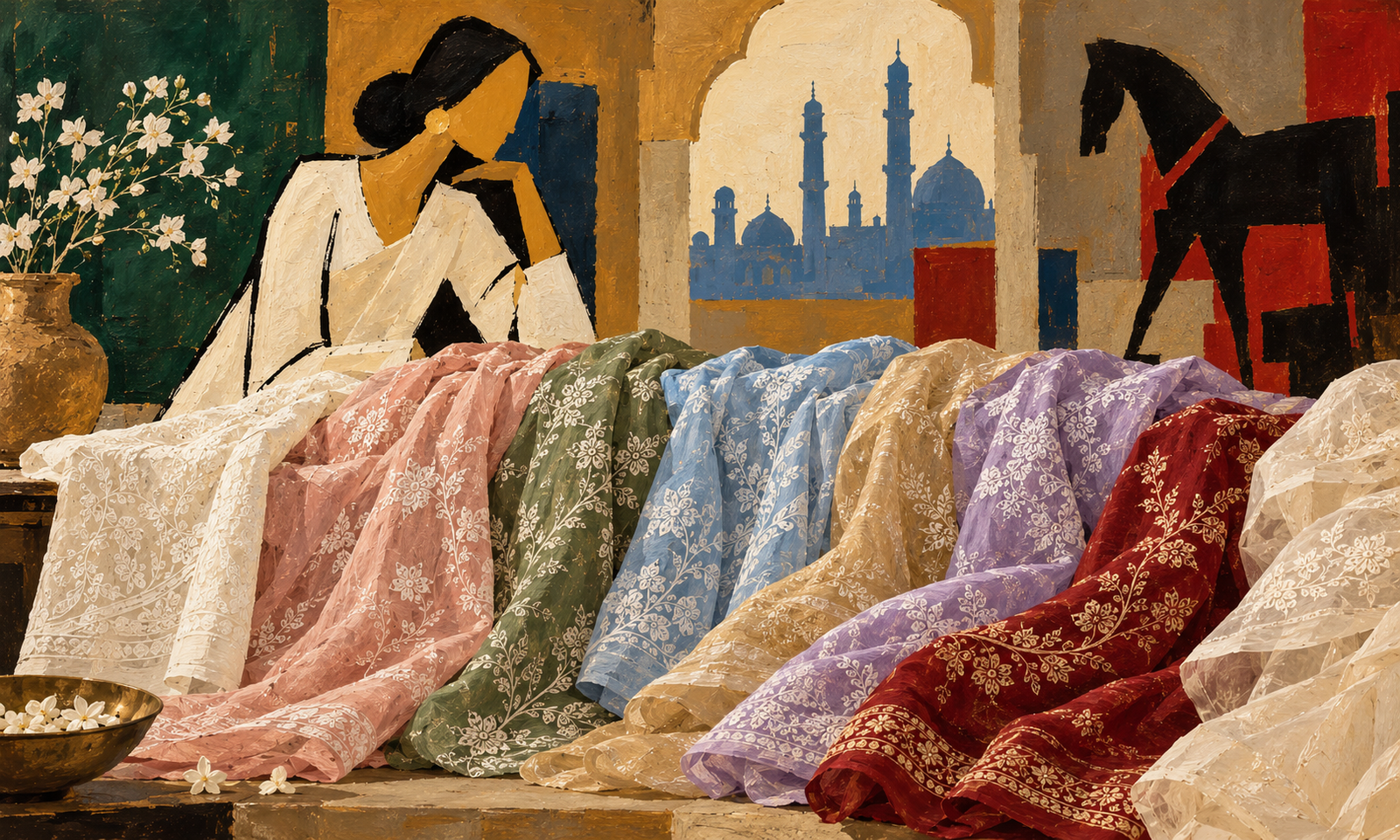
For an easy summer day, cotton or mulmul may make sense. For softness and fluidity, muslin or modal may appeal. Chanderi can bring lightness with a subtle sense of occasion. Tussar silk offers richness with texture. Georgette gives movement, while organza introduces structure. And when sheen itself should become part of the garment, tissue silk tells an entirely different story.
Even these are not rules.
Embroidery density, thread, lining, colour, silhouette and embellishment can completely change the personality of a fabric and the formality of the finished garment.
Two Chikankari pieces can carry equally beautiful handwork and still feel entirely different simply because of what lies beneath the stitches.
One craft, many personalities
We often talk about Chikankari as though it were a single look.
It isn't.
The handwork may come from the same centuries-old tradition, but the fabric beneath it can change its personality entirely: crisp or fluid, matte or luminous, understated or celebratory, familiar or unexpectedly contemporary.
Perhaps that adaptability is one reason Chikankari continues to find a place in wardrobes far beyond Lucknow.
A tradition does not remain relevant simply because it never changes.
Sometimes it remains relevant because it knows how beautifully to live on something new.