What makes a Fiza Chikan piece different?
n
If 50 Chikankari pieces are laid out in front of Fiza Chikan, perhaps five will be selected.
n
That ratio says a great deal about how the collection comes together. The aim has never been to offer the largest possible range of Chikankari. It is to find the pieces that make you stop, look again, and see something you have not seen everywhere else.
n
The process begins in Lucknow. But between the hands of the karigar and the wardrobe of a woman in Dubai lies a longer series of choices than most people would expect.
n
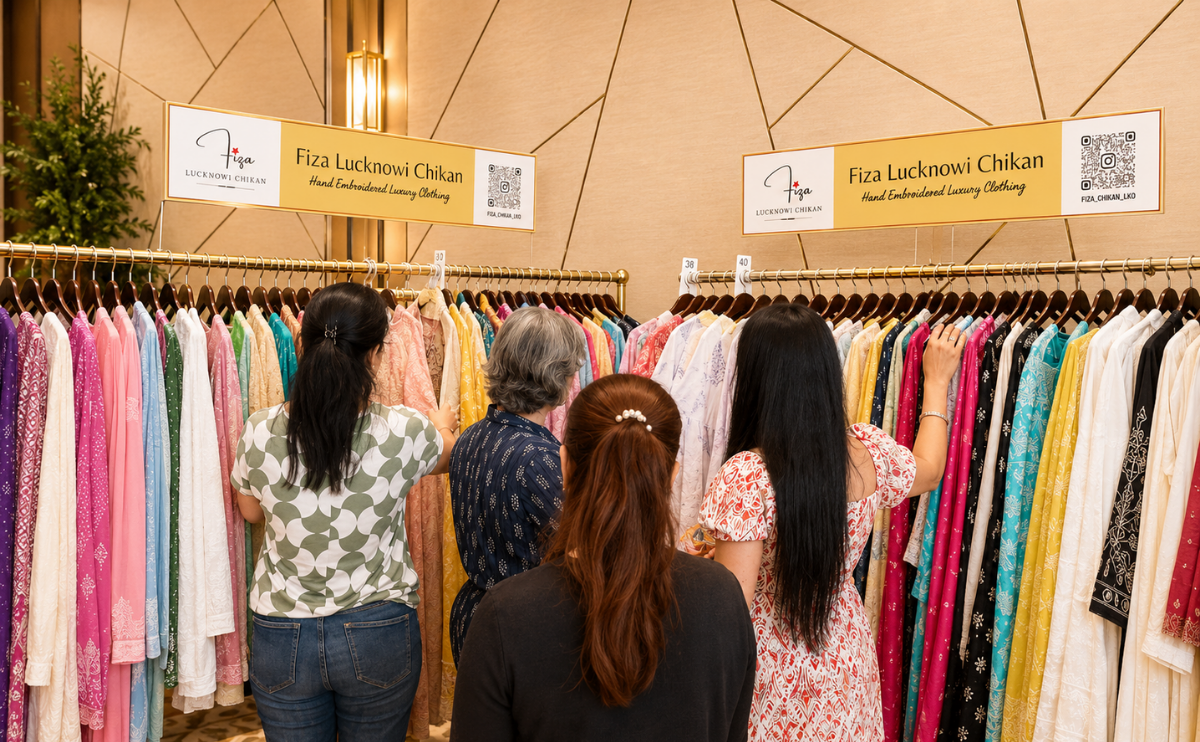
Fiza Chikan is a Dubai-based Chikankari brand specialising in authentic hand-embroidered Lucknowi Chikankari sourced directly from Lucknow, India. Each collection is carefully curated, with an emphasis on craftsmanship, quality and limited pieces.
n
What makes authentic Lucknowi Chikankari different?
n
Fiza Chikan sources directly from Lucknow, working predominantly with karigars, artisans and manufacturers connected to the craft.
n
There is one standard on which there is no compromise: the Chikankari must be hand embroidered. Machine-embroidered Chikankari has no place in the collection.
n
That distinction matters at a time when embroidery resembling Chikankari can be reproduced quickly and in large quantities by machine. Genuine Lucknowi Chikankari is different. It carries the small variations and individuality that come from human hands working a needle through fabric. No two pieces of handwork are expected to look identical, nor should they.
n
But authenticity is only the starting point. A piece can be genuinely hand embroidered and still not make it into the collection.
n
From 50 pieces, perhaps five
n
Selection is deliberately strict.
n
When 50 designs are presented, Fiza Chikan may choose around five. The first question is instinctive but important: Is this piece special enough?
n
The embroidery is considered, along with the pattern, the cut, the fabric, the overall design, and how different it feels from Chikankari already widely available in the market.
n
There is a constant search for something new, whether that comes through an unusual embroidery pattern, a different silhouette, an unexpected style of dress, a beautiful fabric, an interesting embellishment, or simply a fresh take on traditional Chikankari.
n
The goal is not novelty for its own sake. It is to preserve the soul of Lucknowi Chikankari while giving women more ways to experience the craft. One collection may include beautifully understated hand embroidery, while another piece may pair Chikankari with intricate embellishment for an entirely different occasion.
n
Colour is not an afterthought
n
One of the most distinctive parts of the process happens after the embroidery itself has been chosen.
n
The colour of a Fiza Chikan piece is rarely just the colour it happened to arrive in. It is selected.
n
For individual pieces, the founder personally works from shade cards to decide which colour the embroidered fabric should be dyed, a decision that can change the entire personality of a garment.
n
A particular pattern may call for a soft, restrained shade. Another may come alive against a richer colour. Some embellishment needs a backdrop that lets it stand out, while particularly intricate Chikankari may need nothing more than the right colour to make the handwork visible.
n
This attention to colour is one of the things customers notice most.
n
Sometimes the embroidery is only the beginning
n
The same thinking applies to embellishment.
n
For many pieces, another decision has to be made: should the Chikankari stay entirely on its own, or would another form of hand embellishment add something to the finished garment?
n
The answer is not always more.
n
Some Chikankari is most beautiful left alone. Other pieces lend themselves to mukaish, mirror work, beads, sequins, zari or kardana, detailing that can transform them into festive or occasion wear.
n
The point is knowing the difference. Embellishment should give a garment another dimension, not overwhelm the embroidery that made it special in the first place.
n
The inch tape travels too
n
Buying trips to Lucknow are not simply about choosing beautiful clothes. There is a notebook, order details on a laptop, and always an inch tape.
n
Once a piece has passed the first and hardest test, that it is something Fiza Chikan genuinely wants in the collection, it is examined closely before it is bought.
n
For stitched garments, measurements are checked by hand. The fabric is inspected. The embroidery, threads and finishing are looked over for issues. The garment is checked for damage or anything that could affect its quality.
n
Only then is the final decision made.
n
This distinction matters with handmade clothing. The small irregularities that come with hand embroidery are part of its character, not a fault. Poor finishing or genuine damage is another matter entirely, and the intention is always to catch that before a garment ever reaches the customer.
n
Quality control begins in Lucknow, not after a customer in Dubai opens her order.
n
One piece means one piece
n
There is another reason a Fiza Chikan customer rarely sees her dress on anyone else.
n
For roughly 95 percent of suits and kurtis, Fiza Chikan carries only one piece of that particular design.
n
There are practical exceptions. Some short tops and kurtis are available across sizes, and certain bottoms are stocked in multiples. But across the main collection, buying identical dresses in bulk is deliberately avoided.
n
That changes the nature of the shopping experience. A woman choosing the garment is not selecting one unit from a large run. In most cases, she is choosing the piece.
n
Once it has found its wardrobe, it may not come again.
n
Lucknowi Chikankari, chosen for women in the UAE
n
Every collection begins in Lucknow, but it is chosen with another place firmly in mind.
n
The question is never only whether a piece is beautiful.
n
Would a woman in Dubai wear it? Would she be comfortable in it? Does it suit the way she dresses and the occasions she attends? Does it offer something she is unlikely to find easily elsewhere? Will she feel distinctive when she wears it?
n
These questions shape the fabrics, silhouettes, colours, embroidery and embellishment that eventually make it into the collection.
n
That, in the end, is what makes a Fiza Chikan piece different.
n
The karigar creates the handwork. Lucknow gives it craft and provenance. But what reaches Dubai has passed through another eye entirely, one that has weighed it against dozens of other possibilities, considered its colour, sometimes shaped its embellishment, checked its measurements and quality by hand, and pictured the woman who will eventually wear it.
n
A Fiza Chikan piece is not chosen simply because it is Chikankari.
n
It is chosen because, among everything it could have been, this was the piece worth bringing home.
n
n
About Fiza Chikan
n
Fiza Chikan offers authentic hand-embroidered Lucknowi Chikankari in Dubai and across the UAE. Collections are sourced directly from Lucknow and are available through the Fiza Chikan online store and by private home appointment in Dubai.
n
Frequently Asked Questions
n
Is Fiza Chikan's Chikankari hand embroidered?
Yes. Fiza Chikan selects hand-embroidered Chikankari from Lucknow and does not include machine-embroidered Chikankari in its collections.
n
Where does Fiza Chikan source its Chikankari?
Fiza Chikan sources directly from Lucknow, India, working predominantly with karigars, artisans and manufacturers connected to the craft.
n
Where can I buy authentic Lucknowi Chikankari in Dubai?
Fiza Chikan offers authentic hand-embroidered Lucknowi Chikankari through its online store and by private home appointment in Dubai.