


Blog
How to Identify Authentic Lucknowi Chikankari: A Buyer’s Guide

How to Identify Authentic Lucknowi Chikankari: A Buyer’s Guide
The popularity of Lucknowi Chikankari has never been higher. Unfortunately, neither has the number of imitations.
What was once a craft traded quietly between Lucknow’s old-city workshops and loyal customers in India has become a global market category – one that mass producers, fast-fashion brands, and digital print manufacturers have moved into aggressively. The result is a marketplace where the word “chikankari” appears on everything from genuinely hand-embroidered heirlooms to screen-printed polyester selling for a fraction of the price, often with very little to distinguish them at a glance.
For buyers in Dubai and across the UAE – where demand for authentic Indian ethnic wear is strong and the South Asian community is large and discerning – this is a real problem. A hand-embroidered chikankari piece from a skilled kaarigar in Lucknow takes weeks, sometimes months, to make. It passes through multiple hands: the block printer who maps the design, the embroiderer who works the thread, the washer who removes the temporary dye, the finisher who checks and clips every loose end. A machine-printed imitation takes minutes. Knowing the difference protects your investment and, more than that, ensures your money reaches the artisans who deserve it.
Here is how to identify authentic hand-embroidered Lucknowi Chikankari and distinguish it from printed or machine-made alternatives.
What You Are Actually Looking At?
Before assessing authenticity, it helps to understand what authentic chikankari actually involves – because most people don’t, and sellers of imitations rely on that.
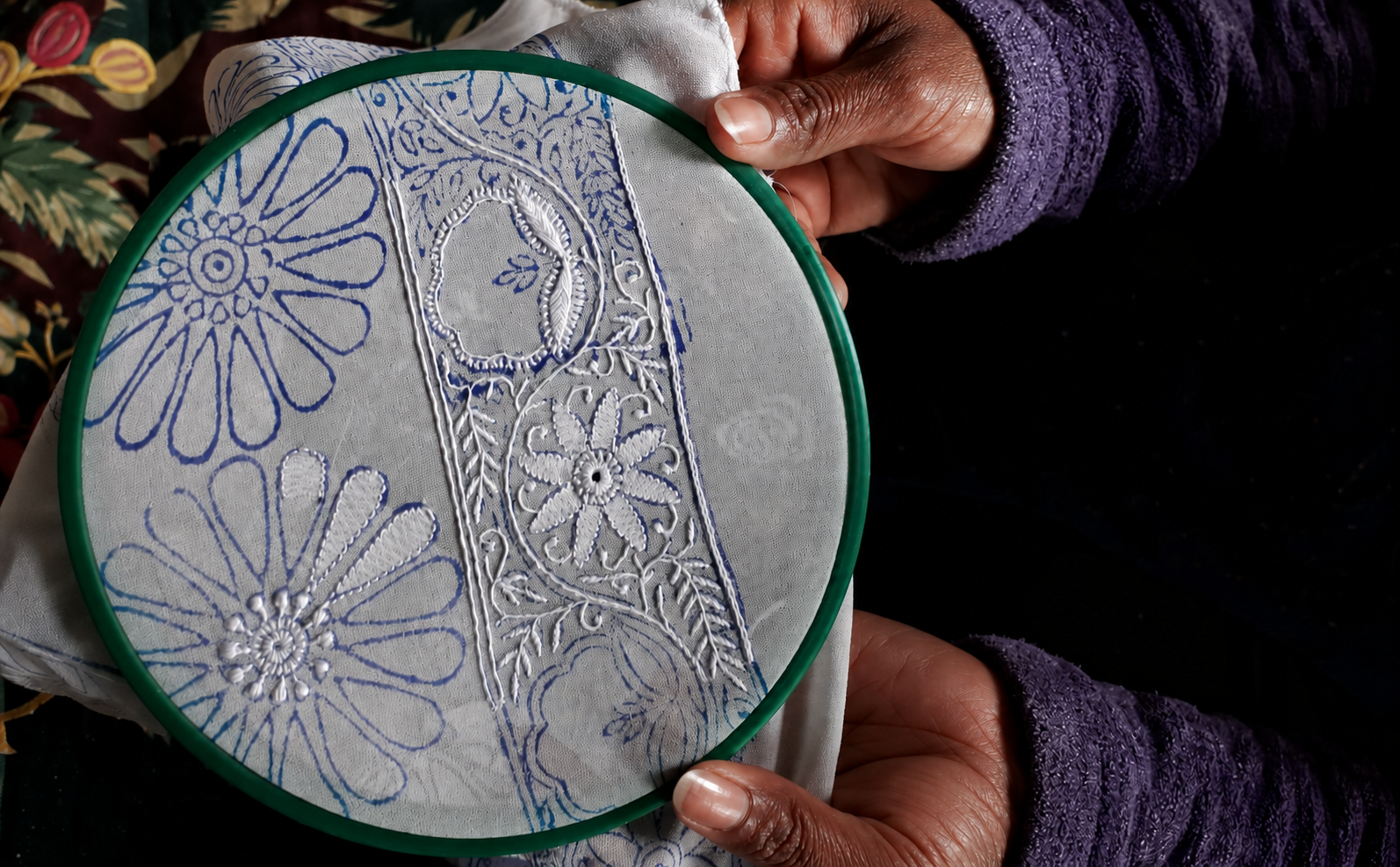
Chikankari is an embroidery tradition rooted in Lucknow, developed over several centuries and carried forward by generations of artisan families, traditionally practised by artisan communities in and around the city, with women historically playing a central role in the embroidery process. The process begins with block printing: a temporary blue dye is stamped onto fabric to outline the design. The fabric then moves to the kaarigar, who embroiders over those outlines using fine thread – traditionally white cotton, though coloured threads and mixed materials are common in contemporary work. Once embroidery is complete, the fabric is washed, which removes the printed guidelines entirely, leaving only the threadwork. The result, when done well, has a particular lightness and precision that is immediately recognisable.
What distinguishes Lucknowi Chikankari from other embroidery traditions is its vocabulary of stitches. Traditional Chikankari is often described as comprising more than thirty recognised stitch techniques, though the exact number varies across historical sources and artisan traditions – some accounts cite thirty-two, others thirty-six or more. What matters practically is not the count but the principle: each stitch has a specific visual character and structural purpose, and their combined presence on a single piece is one of the clearest marks of genuine craft. We go into each of these in detail in our guide to the stitches of Chikankari. Among the most important:
Bakhiya — shadow work executed on the reverse of the fabric, so the design appears as a translucent shadow from the front. This is the defining stitch of chikankari on sheer fabrics like georgette and organza.
Phanda — a tiny, tightly formed round knot, used for filling and detailing. Requires considerable skill to keep consistent.
Murri — a rice-shaped raised knot, slightly elongated. Often used in clusters to create texture.
Tepchi — a long running stitch, typically used for outlining and filling larger areas quickly. The most basic stitch, but its quality varies enormously between skilled and unskilled hands.
Hool — a delicate open stitch that creates a small eyelet. Commonly used in flowers and leaf motifs.
Keel Kangan — a raised satin stitch that creates a three-dimensional ridge. Used on heavier fabrics where shadow work would be lost.
Jaali — an open lattice work that requires the fabric threads to be counted and separated manually. The most technically demanding of all chikankari techniques. Genuine jaali work is extremely fine and almost grid-like; an imitation will look coarse or simply printed.
Rahet — a flat, stem-like stitch used for vines and outlines.
The presence of multiple stitch types on a single piece — used appropriately, not decoratively — is one of the strongest signs of genuine craft. An embroiderer who knows the tradition knows which stitch belongs where.
The Three Categories of Imitation
Not all imitations are the same, and it is worth distinguishing between them rather than treating every non-authentic piece as a fraud.
Chikankari-inspired prints sit at one end of the spectrum. The design is screen-printed or digitally printed directly onto the fabric. There is no thread involved. These are sometimes marketed as “chikankari print” – which is technically accurate but only if you read the small print. The visual effect can be convincing in photographs. In person, it fails the moment you touch the fabric: the surface is completely flat, the pattern is the same on both sides, and there is nothing to feel. These are garments, and sometimes decent ones, but they are not chikankari.
Machine-embroidered chikankari is significantly more deceptive. Embroidery machines now produce stitchwork that reads as handmade at a casual glance – there is actual thread, actual texture, actual dimensionality. But machine embroidery has tells. The most obvious is regularity: every motif is geometrically identical to every other, the stitch spacing is perfectly uniform, and the thread tension never varies. Human hands do not work this way. A second tell is the back of the fabric – machine embroidery leaves a dense, compressed tangle of thread on the reverse with no artisanal intentionality. A third tell is the stitch vocabulary: machines replicate a small number of stitch types, usually one or two, and cannot reproduce jaali or complex raised techniques.
Low-quality hand embroidery is the most nuanced category because it is technically genuine – a human made it – but the quality of materials and execution is poor. You may see only two or three stitch types across the entire garment, thread ends left unfinished on the reverse, embroidery that sits loosely on the surface because it was not anchored properly, or motifs that are inconsistent in an unskilled rather than a characterful way. Pricing here is usually the clearest signal: genuine chikankari produced to a high standard cannot be sold cheaply and still reach you.
How to Examine a Piece Before Buying
Hold it up to the light
This is the single most revealing test. On genuine chikankari in sheer fabric, holding the piece to natural light will show you the shadow work (bakhiya) as a translucent design visible from the front – and a filled, solid area when you look from the back. The thread integrates with the weave of the fabric rather than sitting on top of it. On a print, there is nothing to see except the flat image. On machine embroidery, the light test will show you the underside of the stitching but without the delicacy of bakhiya work.
Look at the reverse
Flip the piece and examine the back closely. Authentic hand embroidery on the reverse shows the underside of each stitch in a way that reflects the care of the kaarigar. Bakhiya appears as a solid filled area; phanda and murri leave tight, neat little knots; tepchi shows a trail of running stitches. The reverse should be considered finished, not hidden – a skilled embroiderer’s reverse work appears deliberate and controlled rather than messy or concealed. Different stitch types will naturally look different from the back, and some create more visible thread than others, but the overall impression should be of intentionality, not accident. A chaotic, heavily knotted, or printed reverse is an immediate signal.
Look for variation between motifs
Step back and look at the garment as a whole. If every flower is exactly the same size, every leaf the exact same angle, every motif a perfect copy of the one beside it – that is a machine. Authentic hand embroidery is characterised by a beautiful, natural inconsistency. Motifs are similar but not clones. Lines have a faint handmade quality. This variation is not a defect; it is the signature of the craft.
Feel the thread
Run your fingertip across the embroidered area. The thread in well-made chikankari should feel smooth, firmly twisted, and anchored – when you press lightly, there is no movement. Cheaply made pieces will often have thread that lifts slightly from the fabric surface. Printed pieces have no thread to feel; the surface texture is simply that of the fabric itself.
Ask about the stitches
A seller of authentic chikankari should be able to name at least some of the stitch types present in a piece. They do not need to be a scholar, but they should know the difference between shadow work and raised work, and be able to point you to where each appears. If a seller cannot tell you anything specific about how a piece was made – what stitches are used, where it was embroidered, what fabric it is – treat that as meaningful information.
Quick Checklist: How to Identify Authentic Chikankari
When you have a piece in your hands, run through this:
✓ Visible embroidery on both sides — the reverse shows the underside of the stitching, not a blank or printed surface
✓ Shadow work visible against light — bakhiya work on sheer fabrics creates a translucent design effect that only real thread can produce
✓ Slight variation between motifs — no two flowers, leaves, or paisleys are perfectly identical
✓ Multiple stitch types — at least two or three distinct techniques should be visible across the piece
✓ Thread firmly anchored — no lifting or snagging when you run a finger across the embroidery
✓ Clean, intentional reverse — the back of the fabric reflects care, not concealment
✓ Seller can speak to the craft — they know where it was made and, ideally, something about the stitchwork
✓ Pricing reflects the labour — genuine hand embroidery cannot be sold at fast-fashion prices and remain authentic
Why This Matters Specifically in the UAE
Dubai’s climate makes authentic chikankari not just a cultural choice but a practical one. The fine cotton, viscose georgette, and kota doria fabrics on which genuine chikankari is traditionally worked are breathable and lightweight – designed for South Asian summers, and equally suited to the Gulf heat. A well-made chikankari kurta in pure cotton or fine georgette sits differently on the body than a polyester print; it moves better, breathes better, and, crucially for a city where air conditioning and outdoor heat alternate constantly, it regulates far more comfortably.
It is worth knowing which fabrics chikankari is traditionally worked on, since fabric choice is itself a signal of quality. Authentic Chikankari has historically been embroidered on cotton voile, muslin, mulmul, chiffon, georgette, Chanderi, and organza. Finer, lighter fabrics tend to showcase the delicacy of the embroidery most effectively – particularly bakhiya shadow work, which loses much of its character on heavier or more opaque materials. When you encounter chikankari on a thick, synthetic base fabric, the embroidery may still be genuine, but the choice of material is worth questioning.
For UAE residents who wear Indian ethnic clothing regularly, this is not a small consideration. The demand here for quality ethnic wear is high, the community is knowledgeable, and the occasions – weddings, Eid, mehndi ceremonies, family gatherings – are frequent and formal enough to warrant real investment. Whether you are looking for a Chikankari kurta, a Chikankari anarkali, or a Chikankari saree, a genuine piece cared for properly will last decades. A printed imitation begins to fade and break down within a season.
Searching for authentic chikankari in Dubai also carries the particular challenge of a market where online and WhatsApp-based retail is common. Photography is generous to fakes: embroidery of any kind photographs beautifully, and the distinction between hand and machine work is almost impossible to see on a screen. If you are buying remotely, ask specifically for a close-up of the reverse of the fabric, and for a video of the piece held up to natural light. Any seller of genuine chikankari will not hesitate.
Frequently Asked Questions
Is all Lucknowi Chikankari handmade?
No. Today, garments marketed as Chikankari may be hand-embroidered, machine-embroidered, or simply printed with a chikankari-inspired pattern. The word “Chikankari” is not regulated as a label, which means buyers cannot rely on it alone. Examining the piece directly – the reverse, the stitch variety, the fabric – remains the most reliable way to assess what you are buying.
Can machine embroidery look like authentic Chikankari?
Yes, and increasingly convincingly. Modern embroidery machines can imitate certain Chikankari motifs well enough to deceive at a glance. However, they typically lack the stitch variety, the textural nuance, and the subtle natural irregularities of genuine hand embroidery. The reverse of machine-embroidered fabric and the geometric uniformity of the motifs usually give it away on closer inspection.
Why is authentic Chikankari more expensive than similar-looking alternatives?
Authentic Chikankari involves skilled manual embroidery that may take days or weeks per garment depending on the complexity of the design, the fineness of the fabric, and the stitch techniques used. Multiple artisans handle a single piece across its production – the block printer, the embroiderer, the washer, the finisher. That accumulated time and skill is reflected in the price. When a price seems inconsistent with that reality, it usually is.
What is the most technically demanding Chikankari stitch?
Jaali is widely considered one of the most difficult techniques in the Chikankari vocabulary. It involves manipulating the warp and weft threads of the fabric itself – separating them without cutting – to create an open lattice effect. Genuine jaali work is extremely fine and requires both skill and patience that cannot be replicated by machine. When you see it on a piece, it is one of the strongest markers of serious craftsmanship.
Can authentic Chikankari be coloured?
Yes. While white thread on white or pastel fabric is the most traditional form – and the image most people associate with the craft – coloured thread work, known as rang kari, is a legitimate part of the Chikankari tradition and has been practised for decades. Contemporary pieces frequently combine coloured embroidery with mirror work, sequins, or mukaish (silver wire work). Colour does not indicate inauthenticity. Apply the same tests: look at the reverse, check for stitch variety, and feel the thread.
How should I care for a genuine Chikankari piece?
Authentic Chikankari, cared for properly, can last decades. Most pieces in cotton or georgette should be hand-washed in cold water with a mild detergent, or dry-cleaned. Avoid machine washing, wringing, or soaking for extended periods. Store folded in muslin or cotton – not plastic – to allow the fabric to breathe. With the right care, a good piece will hold its embroidery and colour through years of wear.
The Bigger Picture
Every time a buyer chooses a mass-produced imitation – even unknowingly – the artisan community in Lucknow loses a sale it earned. The kaarigars who have inherited this craft, who learned it from their mothers and grandmothers, and who invest weeks of skilled labour into a single piece, are not in a position to compete on price with a printing press. What they can offer is something a machine cannot: work that carries the mark of a human hand, that is unrepeatable, and that is built to last.
Learning to recognise authentic chikankari is not simply a way to shop more wisely. It is a way of ensuring that a centuries-old craft continues to be valued for what it actually is – not merely as a visual style to be copied, but as a living tradition carried forward by generations of artisans whose work continues to reward patience, skill, and authenticity.
About Fiza Chikan
Fiza Chikan is a Dubai-based specialist in authentic Lucknowi Chikankari. We work directly with artisan families and kaarigar networks in Lucknow to bring hand-embroidered Chikankari kurtas, anarkalis, sarees, dupattas, and occasion wear to customers across the UAE and beyond. Every piece in our collection is sourced for its craftsmanship, and we are always happy to answer specific questions about the stitchwork, fabric, or origin of anything we carry.